


SHOW DAY
20th May
While I was assigned to work as a lighting technician for the gig, I also gave my assistance in other aspects where necessary. This meant the first job of the day was collecting together any gear being taken from college, and loading it up into our transportation which ended up being three cars including my own. We then unloaded this at the venue and got everything setup onstage.
Once this was complete, I was able to head up to the box and identify that the desk I would be using to busk lighting for this gig would be a Titan Mobile which Avolites software, something I identified as an industry standard for this kind of job in my research, which provided me some prior knowledge and comfortability with the layout and functions. Along with this, the venue's lighting technician Toby Clayton gave me a quick run through of how the desk was set up.


SETUP OF DESK
The first 4 faders are for intensity of the 4 lighting fixture types; spots, bars, pars and strobes. The next 3 'faders' are actually tap tempo buttons for the effects on the spots, bars and pars. The next 2 adjust the speed and size of the movement effects on the spots, and the final fader controls the speed of the strobe function. The strobes are assigned to a number of the soft keys on the top right of the desk, along with bumps for all of the lights in various patterns.
Each intensity fader has a coloured border around its name, and this corresponds with the coloured borders around the colour palette selections in the top left. This also correlates with the various effects in the centre panel. To the left of this are pre-set positions for the spots, and extra faders for the front lights, and the speed of the pixel-mapping effect on the bars. To the right of the centre panel is the gobo window, where you can select the shape of the gobo, the spin speed and whether the prism is used.
I had a short period learning this to play around with the software, then once doors had opened I decided the best preparation I could do for the show now the setlist was finalised was write onto the set list a colour scheme for each song. This meant I always had somewhere to start from, while the rest I would have to come up with as I watched the performances. I knew some songs on the set list, but even then you cannot predict the dynamics of a bands performance of it, so it was important I was attentive and reactive in finding ways to keep the lights in line with the performances.
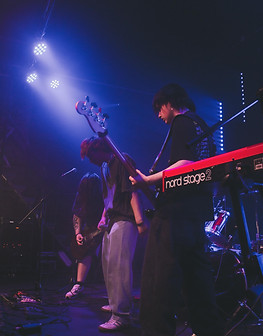
The gig started mostly acoustic and progressed through into metal, which worked well in allowing me to start with basic lighting and steadily advance them as the energy of the songs picked up. In the end I was able to utilise quite a variety of the effects throughout the show, some of which are shown in the videos below.

Use of Effects
No.1 - Gobo spots with movement effects (in this case a tilt)
No.2 - Backlight effect with gobo spots (by using speed and size of movement to position and stop them where needed)
No.3 - Fade chase across spots
No.4 - No fade chase across spots (and using tap tempo)
No.5 - Strobe effect across spots and strobe panels
No.6 - Chase effect across bars (tap tempo) + bumping the strobe panels (soft keys)
No.7 - Colour fades (press a number on key pad for fade time before selecting colour)
'Vibe and Thrive' Gallery




Final EvAluation
This event provided me great experience of freelancing in the music industry, using an industry standard software (as identified in my research) and desk in a real venue, and busking the lights, which is a common practice in venues of this size. As hoped in my SWOT analysis, this provided a great opportunity to work on broadening my knowledge across different lighting software, as I identified my lack of knowledge beyond ChamSys as a weakness. I was also able to consolidate and broaden my knowledge across a wider range of lighting fixtures than I usually have available at college, which was a thoroughly enjoyable opportunity for me. I had a lot of fun in particular using the gobo spots and strobe panels, and was able to use them for some really cool effects, bumps and strobes.
I feel I could've improved by creating slightly more diverse lighting throughout the show, which could be achieved with more planning however this was difficult with the set lists being finalised so late. The small amount of albeit last minute organisation in deciding a colour scheme for each song did help ensure a diverse set of colours to prevent anything feeling too repetitive, and gave me a good starting point to build from. In this, I was also able to communicate with performers and satisfy any requests they had, which was particularly important for their original tracks that I had no prior knowledge of to base my choices on.
Diversity in the lighting for this kind of setup and operation will also build as I have more time and experience with the software and fixtures, as I was trying to experiment and learn as I went along, but while trying to keep up with the bands live I did miss out some potential effects I could've tried, such as using the prism on the gobo spots, or utilising more of the bumps and strobes available on the soft keys. I was still able to demonstrate use of a good range of effects, utilising various chase effects across all 3 head types these and available on, and match these really well to the song dynamic and tempo. The very fact I was able to use the effects I did demonstrates my strength of adaptability identified in my SWOT, as I was able to created a dynamic light show live on a software I had a very short window to become familiar with.
Throughout setup for the gig, I also demonstrate good communication and teamwork in ensuring we got everything done in the short time we had, even showing leadership and delegation skills when I felt we were not getting things done quick and efficiently enough. In her feedback form, the event organiser Charlotte agreed with this saying I "worked very well with the performers, workers at the venue and (her)" and "helped others with their job roles".
Ultimately, I was very satisfied with the results of the lighting I provided, and received several in person compliments on the night from audience members. Charlotte in her feedback form said she also "only heard positive reviews about the lights on the night of (the) gig" and gave me a 5/5 rating for her satisfaction with the final tech result, as well as responding 'Yes' when asked if in a professional context she would consider me for future roles based on my work for this event. This is very valuable to me as freelancing relies a lot on building connections and a positive reputation.